

This simple wedding sheet cake recipe delivers an elegant, scalable dessert with vanilla bean crumb and silky stabilized buttercream—no tiers, no fuss, just clean slices and classic flavor that works for 25 guests or 250. I’ve built this cake around one core principle: a tender, moist vanilla crumb that holds its structure under frosting, paired with a buttercream stable enough to transport and beautiful enough to skip the fondant entirely. The vanilla bean isn’t decoration—it’s the texture contrast, the visual signature, and the flavor anchor that makes this cake feel intentional rather than basic.
Why You’ll Love This
- Scales easily: one 9×13 pan serves 24; double or triple the recipe and stack pans for larger crowds without changing technique
- Transport-friendly: sturdy crumb and stable buttercream mean clean edges and zero frosting collapse in a car or venue kitchen
- Minimal equipment: one bowl for dry, one for wet, one mixer, one offset spatula—sheet cake simplicity with wedding-cake polish
- Make-ahead structure: bake 2 days ahead, crumb coat 1 day before, final frosting 4 hours before service
- Flavor flexibility: vanilla bean is the anchor, but the buttercream takes color, extract swaps, and garnish direction without hesitation
Ingredient Breakdown
For the Cake
- 2 1/4 cups all-purpose flour
- 2 teaspoons baking powder
- 1/2 teaspoon baking soda
- 1/2 teaspoon fine sea salt
- 1 vanilla bean pod, split and scraped (or 2 teaspoons vanilla extract)
- 1/2 cup unsalted butter, room temperature
- 1 1/2 cups granulated sugar
- 3 large eggs, room temperature
- 1/2 cup sour cream, room temperature
- 1/2 cup whole milk, room temperature
For the Vanilla Bean Buttercream
- 1 pound unsalted butter, room temperature
- 4 cups powdered sugar, sifted
- 2-3 tablespoons heavy cream or whole milk
- 1 vanilla bean pod, split and scraped (or 1 1/2 teaspoons vanilla extract)
- 1/4 teaspoon fine sea salt
- 1 tablespoon cornstarch (for stability)
The vanilla bean is non-negotiable here—the flecks anchor the visual and flavor story. If you’re scaling up, buy whole beans in bulk; they’re cheaper and you’ll use them. The cornstarch in the buttercream is the stability secret: it absorbs moisture and prevents weeping during transport and warm venues.
Whirl Hook
The signature of this cake is the marriage of tender crumb and stable frosting. I’m using vanilla bean as both the flavor anchor and the visual anchor—those flecks tell you this is intentional, not rushed. The buttercream gets cornstarch for structure and heavy cream for silkiness, so it pipes clean edges, holds detail, and travels without collapse. This is the cake you bake when you want elegance without complexity.
Flavor Spin
Vanilla bean is the core twist here, but the buttercream is where the texture contrast lives. You’re building a silky, stable frosting that’s spreadable enough to crumb coat but firm enough to hold piped detail. The cornstarch is the secret: it stabilizes without adding grittiness, and it lets you frost 4 hours ahead without the buttercream breaking or sweating. Add lemon zest to the frosting for brightness, or infuse the milk with earl grey for subtle floral depth—the crumb is neutral enough to support any flavor direction.
Step-by-Step
- Preheat your oven to 350°F. Grease a 9×13-inch baking pan, line the bottom with parchment, and grease the parchment. This two-layer approach prevents sticking and makes removal clean.
- Whisk together flour, baking powder, baking soda, and salt in a medium bowl. Set aside.
- In a small bowl, combine the vanilla bean scrapings (or extract) with the sour cream and milk. Let sit 1-2 minutes so the vanilla distributes evenly.
- In a large mixing bowl, cream the butter and sugar together on medium speed for 4-5 minutes until pale, fluffy, and noticeably lighter in color. Stop and scrape the bowl halfway through.
- Add eggs one at a time, beating on medium speed for 30-45 seconds after each addition. The mixture should look smooth and emulsified, not separated or curdled.
- Reduce mixer speed to low. Add one-third of the dry ingredients, then half of the wet ingredients. Mix until just combined. Repeat: one-third dry, remaining wet, then final dry. Scrape the bowl between additions.
- Pour batter into the prepared pan and smooth the top with an offset spatula. Tap the pan gently on the counter 2-3 times to release air bubbles.
- Bake 28-32 minutes until a toothpick inserted in the center comes out with a few moist crumbs (not wet batter, not completely clean). The edges should pull slightly from the sides of the pan.
- Cool in the pan for 15 minutes, then turn out onto a wire rack. Cool completely—at least 2 hours—before frosting. The cake must be cool or the buttercream will melt.
Whirl Factor
The texture contrast is crumb versus frosting: tender, moist cake against silky, stable buttercream. The vanilla bean flecks create visual interest and signal quality without needing decoration. This is purposeful restraint—the cake is the star, not the frosting technique. When you slice it, the crumb should be even and moist, the frosting should hold its edge without cracking, and the vanilla should taste like vanilla, not extract and sugar. That’s the Whirl Factor: elegance built on technique, not decoration.
Visual Cooking Timeline
- 0:00 — Preheat oven to 350°F, grease and line 9×13 pan
- 0:05 — Whisk dry ingredients (flour, baking powder, baking soda, salt), set aside
- 0:08 — Combine vanilla bean with sour cream and milk
- 0:10 — Cream butter and sugar until pale and fluffy (4-5 minutes)
- 0:15 — Add eggs one at a time, beating 30-45 seconds each
- 0:20 — Alternate dry and wet ingredients on low speed, starting and ending with dry
- 0:22 — Pour batter into pan, smooth top, tap to release bubbles
- 0:25 — Bake 28-32 minutes until toothpick comes out with moist crumbs
- 0:55 — Cool in pan 15 minutes, turn out onto rack, cool completely (2+ hours)
- 3:00 — Cake ready for crumb coating or frosting
Spin Options
Lemon Verbena Buttercream
Infuse the heavy cream with dried lemon verbena (steep 5 minutes, strain) and replace one vanilla bean with the zest of 1 lemon. The crumb stays neutral, but the frosting becomes bright and garden-forward—perfect for spring weddings.
Earl Grey Silk Frosting
Steep 1 teaspoon loose earl grey tea in the heavy cream (5 minutes), strain, and use that cream in the buttercream. Skip the second vanilla bean and add 1/4 teaspoon almond extract instead. The cake becomes sophisticated without being obvious.
Honey-Vanilla Frosting
Replace 1/2 cup of the powdered sugar with 1/4 cup honey and reduce the cream to 1-2 tablespoons. The frosting becomes slightly softer and more luxurious, with subtle floral depth. Honey also adds stability and a slight sheen.
Whirl Finish
Frost the cooled cake with a thin crumb coat (30 minutes in the fridge), then apply the final frosting layer. Use an offset spatula to create a clean, flat top and smooth sides, or leave it intentionally rustic with visible spatula marks—both read as intentional. Add a pearl border, fresh flowers, or scatter candied lemon peel around the edge if you want detail. Chill the frosted cake for at least 2 hours (or up to 4) before transport. The buttercream will set firm enough to hold detail and travel without collapse.
Quick Tips
- Room temperature matters: cold eggs and dairy won’t emulsify properly. Pull everything from the fridge 30 minutes before mixing.
- Don’t overmix: stop as soon as the dry ingredients disappear. Overmixing develops gluten and makes the cake dense and tough.
- The cornstarch is not optional: it stabilizes the buttercream and prevents weeping in warm venues. Use it every time.
- Freeze unfrosted cakes up to 1 week wrapped tightly in plastic. Thaw at room temperature before frosting—no condensation issues.
- If the buttercream breaks or looks grainy, add 1 tablespoon of heavy cream and beat on low speed for 2-3 minutes. It will come back together.
Substitution Ideas
- Greek yogurt → sour cream — Use equal parts; the cake will be slightly tangier and slightly more tender. No change to bake time.
- Cake flour → all-purpose flour — Use 2 1/2 cups cake flour (it’s lighter). The crumb will be more delicate; reduce bake time by 2-3 minutes.
- Almond extract + vanilla — Replace 1/2 teaspoon of vanilla with 1/4 teaspoon almond extract. The flavor becomes rounder without tasting like almonds.
- Dairy-free buttercream — Use vegan butter (same weight) and oat or almond milk instead of heavy cream. The texture will be slightly softer; add 1 extra tablespoon of cornstarch for stability.
- Scaling up — Double or triple the recipe and bake in two or three 9×13 pans. Bake time stays the same. Stack cooled cakes with frosting between layers.
Make-Ahead Options
2 days before: Bake the cakes, cool completely, wrap tightly in plastic wrap, and store at room temperature or in the fridge. Cakes stay moist and tender for up to 3 days. 1 day before: Make the buttercream and store in an airtight container at room temperature (or in the fridge if your kitchen is warm). Bring to room temperature and re-whip for 1-2 minutes before frosting. Apply the crumb coat and chill for 30 minutes. 4 hours before service: Apply the final frosting layer, add any garnish, and chill until transport. The buttercream will set firm enough to hold detail and travel safely. Do not make ahead: Don’t frost the cake more than 4 hours before service in very warm venues—the buttercream can soften and lose definition. If your venue is over 75°F, keep the cake in a cooler until 30 minutes before cutting.
FAQ
Can I make this cake the day before the wedding?
Yes. Bake 2 days ahead, crumb coat 1 day ahead, and apply final frosting 4 hours before service. This gives you the most control and the steadiest frosting finish.
How do I transport a frosted sheet cake?
Place the frosted cake on a flat, non-slip surface (a damp kitchen towel under the cake board works). Drive slowly, avoid sudden turns, and keep the cake level. The cornstarch in the buttercream prevents sweating and collapse during transport.
Can I use vanilla extract instead of vanilla bean?
Yes, use 2 teaspoons in the cake batter and 1 1/2 teaspoons in the buttercream. You’ll lose the visual flecks, but the flavor will be solid. If you want the visual, add a pinch of ground vanilla bean or scrape a pod over the finished frosting.
What if my buttercream is too soft?
Add 1-2 tablespoons more powdered sugar and beat on low speed for 1-2 minutes. If it’s still soft, chill for 15 minutes and re-whip. The cornstarch should help, but cold butter is the real fix.
How many servings does one 9×13 pan make?
One pan yields 24 servings (2-inch squares). For smaller slices, cut into 30-36 pieces. For larger slices, cut into 12-15 pieces.
Can I add food coloring to the buttercream?
Yes, use gel food coloring (liquid coloring can thin the frosting). Add a few drops and beat until the color is even. Gel coloring is concentrated, so you need less and it won’t affect the frosting’s texture.
How long does this cake keep?
Unfrosted cake keeps 3 days at room temperature or 1 week in the fridge, wrapped tightly. Frosted cake keeps 2 days at room temperature (in a cool kitchen) or 3 days in the fridge. Do not freeze frosted cake—the buttercream can separate during thawing.
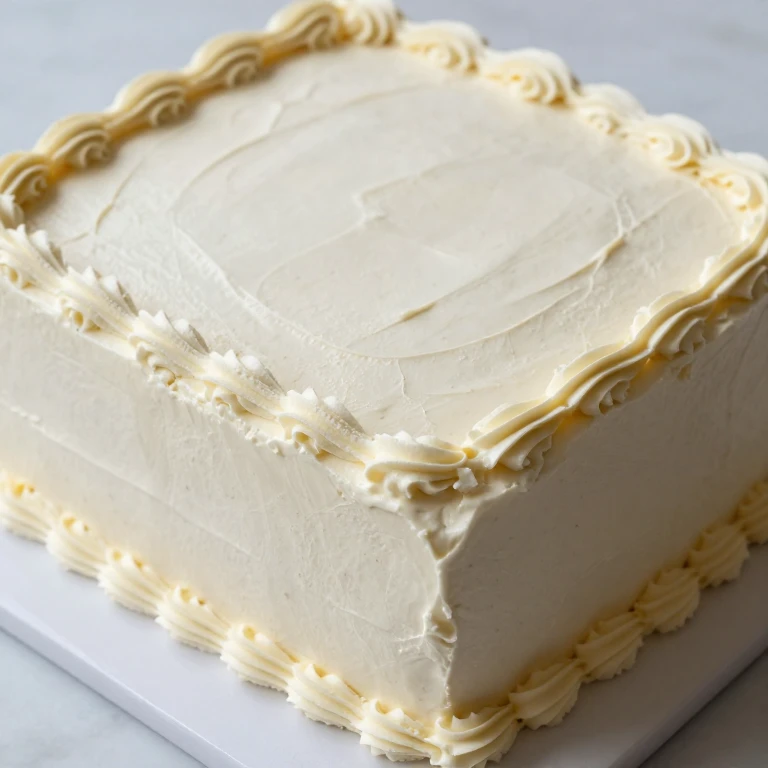
Simple Wedding Sheet Cake With Vanilla Bean Buttercream
Ingredients
Method
- Preheat your oven to 350°F. Grease a 9×13-inch baking pan, line the bottom with parchment, and grease the parchment.
- Whisk together flour, baking powder, baking soda, and salt in a medium bowl. Set aside.
- In a small bowl, combine the vanilla bean scrapings with the sour cream and milk. Let sit 1-2 minutes so the vanilla distributes evenly.
- In a large mixing bowl, cream the butter and sugar together on medium speed for 4-5 minutes until pale, fluffy, and noticeably lighter in color.
- Add eggs one at a time, beating on medium speed for 30-45 seconds after each addition. The mixture should look smooth and emulsified.
- Reduce mixer speed to low. Add one-third of the dry ingredients, then half of the wet ingredients. Mix until just combined. Repeat: one-third dry, remaining wet, then final dry.
- Pour batter into the prepared pan and smooth the top with an offset spatula. Tap the pan gently on the counter 2-3 times to release air bubbles.
- Bake 28-32 minutes until a toothpick inserted in the center comes out with a few moist crumbs. The edges should pull slightly from the sides of the pan.
- Cool in the pan for 15 minutes, then turn out onto a wire rack. Cool completely—at least 2 hours—before frosting.
- For the buttercream: Beat room temperature butter on medium speed for 2-3 minutes until pale and creamy. Gradually add powdered sugar, one cup at a time, beating on low speed.
- Add vanilla bean scrapings, salt, and cornstarch. Beat on low speed until combined, then increase to medium speed and beat for 2-3 minutes until light and fluffy.
- Add heavy cream 1 tablespoon at a time until the frosting reaches spreadable consistency. The cornstarch will stabilize the frosting as it sits.
- Apply a thin crumb coat to the cooled cake and chill for 30 minutes. Apply the final frosting layer with an offset spatula, creating clean edges or intentional texture marks.
- Chill the frosted cake for at least 2 hours (or up to 4 hours) before transport or service.