

When I set out to build a wedding sheet cake that actually delivers on elegance, I knew the crumb had to do the heavy lifting. Most sheet cakes are forgettable—dense, dry, or one-dimensional in flavor. I wanted something that slices cleanly, holds its shape at room temperature during a reception, and tastes like you’ve invested real skill. Enter the almond-vanilla crumb: tender but structured, with subtle nuttiness that reads as refined without screaming “fancy.”
What makes this version worth your time is the stability built into every layer. The buttercream holds its shape at 70°F, the cake stays moist for 48 hours, and the finish is clean enough for a modern tiered look or a simple, elegant border. I’ve scaled this recipe to work for standard sheet pans, and I’ve included the make-ahead timelines so you can bake days ahead if needed. No stress, no last-minute frosting collapse.
Whether you’re baking for an intimate celebration or testing your technique before a bigger event, this recipe gives you the structure and flavor payoff to feel confident. Let’s build this cake.
Quick Snapshot
- Prep Time: 20 minutes
- Bake Time: 28-32 minutes
- Cool Time: 1 hour (cake), 30 minutes (buttercream)
- Total Time: 2 hours 20 minutes
- Yield: One 13×18-inch sheet cake (24-30 servings)
- Texture: Tender, moist crumb with subtle almond nuttiness; smooth, stable buttercream
- Flavor Profile: Warm vanilla with delicate almond undertone
- Skill Level: Intermediate
Why This Recipe Works
The almond-vanilla crumb achieves tenderness through a specific ratio of butter to sugar, plus the addition of almond extract and finely ground almond flour. This combination creates a cake that’s moist without being heavy, and the almond flour adds structure that prevents the cake from drying out over 48 hours. I use both vanilla extract and almond extract because the almond needs a strong vanilla backbone to shine without tasting artificial.
The buttercream formula is built for stability at room temperature. I cream the butter longer than most recipes recommend—about 5-6 minutes—to incorporate air and create a lighter texture that won’t slide off the cake. The ratio of butter to powdered sugar (1:2 by weight) gives you a frosting that’s spreadable but holds detail. If your kitchen is warm, this buttercream won’t weep or separate.
Baking at 350°F for 28-32 minutes (not a second longer) ensures the cake is set but still tender. I check doneness with a toothpick inserted into the center—it should come out with one or two moist crumbs, not completely clean. This is the difference between a cake that stays moist through day two and one that dries out by evening.
Ingredient Overview
For the Cake
- 2 cups (240g) all-purpose flour
- 1/2 cup (45g) finely ground almond flour
- 2 teaspoons baking powder
- 1/2 teaspoon kosher salt
- 1 cup (200g) granulated sugar
- 1/2 cup (113g) unsalted butter, room temperature
- 3 large eggs, room temperature
- 1/2 cup (120ml) whole milk, room temperature
- 2 teaspoons vanilla extract
- 1/2 teaspoon almond extract
For the Buttercream
- 1 cup (226g) unsalted butter, room temperature
- 4 cups (480g) powdered sugar, sifted
- 2 teaspoons vanilla extract
- 1/4 teaspoon almond extract
- 2-3 tablespoons whole milk (as needed for consistency)
- Pinch of kosher salt
The almond flour here is crucial—use a finely ground version (blanched, if possible) so it integrates smoothly into the batter without creating a gritty texture. Coarse almond meal will compromise the crumb structure. If you can’t find finely ground almond flour, you can substitute an additional 1/2 cup of all-purpose flour, though you’ll lose the subtle almond flavor and some of the moisture-retention benefit.
Room-temperature ingredients are non-negotiable. Cold eggs and butter will create a broken batter that traps air unevenly, leading to a dense cake with large tunnels. Pull everything out of the fridge 30 minutes before mixing. For the buttercream, the butter must be soft enough to leave a slight indent when you press it, but not oily or greasy. This is what gives you that light, spreadable texture that holds its shape.
Whirl Hook
This wedding sheet cake is built on a bold contrast: a tender, almond-forward crumb that stays moist for days, paired with a stable buttercream that holds clean lines at room temperature. The twist is the almond flour—it deepens the flavor while locking in moisture, so your cake tastes fresh on day two. No dry cake, no weeping frosting, no compromises.
Flavor Spin
The core flavor pairing is warm vanilla with delicate almond undertone. I use both vanilla extract and almond extract because almond alone can taste artificial, but vanilla gives it grounding and elegance. The almond flour adds a subtle nuttiness that reads as sophisticated without being loud. This combination works beautifully at room temperature—the flavors open up as the cake warms, so you get more complexity than you’d expect from a sheet cake.
Whirl Factor
The texture contrast is where this cake earns its place on a wedding table. The crumb is tender enough to slice cleanly with a hot knife, but structured enough to hold its shape when plated. The buttercream is smooth and light, not greasy or heavy. Together, they create a cake that looks modern and elegant, but tastes like someone who knows what they’re doing made it. You get the visual payoff and the flavor payoff in the same bite.
Step-by-Step Instructions
Prepare the Pans and Oven
- Position your oven rack in the center and preheat to 350°F. Line a 13×18-inch sheet pan (or two 9-inch round pans, if scaling) with parchment paper, letting it extend up the sides. Lightly butter the parchment. This prevents sticking and makes removal clean.
Mix the Dry Ingredients
- In a medium bowl, whisk together the all-purpose flour, almond flour, baking powder, and salt. Set aside. Whisking combines the leavening evenly throughout the flour, preventing dense pockets in the finished cake.
Cream the Butter and Sugar
- In a large bowl, beat the softened butter and granulated sugar together on medium-high speed for 5-6 minutes, until the mixture is pale, fluffy, and noticeably lighter in color. This step is critical—you’re incorporating air that will give the cake its tender crumb. Scrape the bowl halfway through.
- The mixture should look like wet sand or soft clouds, not dense or greasy. If it looks separated or broken, your butter was too cold or your eggs are about to be too cold. Stop and check temperatures before proceeding.
Add the Eggs
- Add the eggs one at a time, beating on medium speed for about 30 seconds after each addition. Make sure each egg is fully incorporated before adding the next. Scrape the bowl between additions. This gradual incorporation prevents the batter from breaking and ensures even distribution.
- After all three eggs are in, the batter should look smooth and creamy, not curdled or separated. If it looks broken, add a tablespoon of flour and beat for 30 seconds to help it emulsify.
Combine Wet and Dry
- Add the vanilla extract and almond extract to the batter and mix on low speed for 10 seconds to combine.
- Add one-third of the dry ingredients and mix on low speed for about 20 seconds, until just combined. Add half of the milk and mix for 15 seconds. Repeat: another third of dry ingredients, then the remaining milk, then the final third of dry ingredients. This alternating method prevents overmixing, which would toughen the crumb.
- After the final addition, mix on low speed for just 5-10 seconds. The batter should look smooth and homogeneous, with no streaks of flour. Overbeating at this stage is the most common mistake—it develops gluten and creates a dense, tough cake.
Transfer and Bake
- Pour the batter into the prepared pan and smooth the top with an offset spatula. The batter should be level and even.
- Bake for 28-32 minutes, until a toothpick inserted into the center comes out with one or two moist crumbs (not clean, but not wet batter). The edges should be just beginning to pull away from the pan. Overbaking by even 2 minutes will dry out the cake—watch carefully in the final minutes.
- Remove from the oven and let cool in the pan for 15 minutes. The cake will continue to cook slightly from residual heat. After 15 minutes, invert onto a wire rack (or leave in the pan if you prefer) and cool completely, about 45 minutes to 1 hour. The cake must be completely cool before frosting, or the buttercream will melt and slide.
Make the Buttercream
- While the cake cools, beat the softened butter on medium-high speed for 2-3 minutes, until it’s very pale and fluffy. This incorporates air, which lightens the frosting and prevents it from being dense or greasy.
- Add the powdered sugar 1 cup at a time, beating on low speed after each addition until incorporated. After all the sugar is in, increase the speed to medium-high and beat for another 3-4 minutes, until the frosting is light, fluffy, and pale. Scrape the bowl frequently.
- Add the vanilla extract, almond extract, and salt, and beat on low speed for 10 seconds to combine. Add milk 1 tablespoon at a time until the frosting reaches a spreadable consistency—it should hold stiff peaks but be soft enough to spread without tearing the cake. If it’s too thick, add more milk; if it’s too thin, refrigerate for 10 minutes and beat again.
Frost and Finish
- Once the cake is completely cool, place it on a serving board or cake base. If the cake is domed, level it with a serrated knife for a clean finish. Use an offset spatula to spread a thin crumb coat of buttercream over the entire cake, covering all exposed crumbs. Refrigerate for 15 minutes so the crumb coat sets.
- Apply the final coat of buttercream, working from the center outward and using smooth, deliberate strokes. For a modern, clean finish, use a bench scraper dipped in hot water (and dried) to smooth the sides and top. For a more textured finish, leave subtle swirls. The choice is yours—this buttercream is stable enough to hold either approach.
Pro Tips for Best Results
- Room Temperature Is Everything: Cold ingredients create a broken batter and uneven crumb. Pull butter, eggs, and milk out 30 minutes before mixing. If you’re in a rush, set the eggs in warm water for 5 minutes to warm them quickly. A broken batter will give you a dense, crumbly cake that falls apart when you slice it.
- Don’t Overbake: The difference between moist and dry is literally 2 minutes. Start checking at 26 minutes. The toothpick should come out with a few moist crumbs, not clean. The cake will continue to cook slightly after it comes out of the oven, so err on the side of slightly underbaked.
- Stabilize the Buttercream in Warm Kitchens: If your kitchen is above 72°F, refrigerate the finished buttercream for 20 minutes before frosting. This firms it up just enough that it won’t slide or weep. You can also add 1 tablespoon of meringue powder or 1/4 teaspoon of gum tragacanth to the buttercream for extra stability, though it’s not required.
- Level the Cake for Clean Slices: A domed cake will slice unevenly and look unprofessional. Use a serrated knife and a gentle sawing motion to level the top. Save the scraps for a trifle or crumb topping—nothing goes to waste.
- Chill Before Serving: If you frosted the cake more than 2 hours ahead, refrigerate it for 30 minutes before serving. This firms up the buttercream so slices come out clean. Let it sit at room temperature for 10 minutes before cutting so the cake is tender, not cold and dense.
- Use a Hot Knife for Clean Slices: Dip a long serrated knife in hot water and wipe it dry between each slice. This melts the buttercream slightly and prevents dragging. A hot knife is the difference between a ragged slice and a professional-looking cut.
Spin Options
Lemon-Almond Variation
Swap the vanilla extract for 2 teaspoons of lemon extract, and add the zest of 2 lemons to the batter after creaming the butter and sugar. The almond flour will complement the bright citrus beautifully. For the buttercream, use only 1 teaspoon of vanilla extract and add 1/2 teaspoon of lemon extract plus the zest of 1 lemon. This version is lighter and more summery, perfect for a daytime celebration.
Cardamom-Almond Variation
Add 1/2 teaspoon of ground cardamom to the dry ingredients. Cardamom is warm and slightly floral, and it pairs beautifully with almond and vanilla. Use the same buttercream, but add 1/4 teaspoon of cardamom to the frosting as well. This variation feels more sophisticated and works especially well if you’re planning an elegant, modern finish.
Brown Butter-Almond Variation
Brown the butter before creaming it with the sugar. This adds a nutty, toasted depth that makes the almond flavor even more pronounced. Let the brown butter cool to room temperature before creaming. The rest of the recipe stays the same. This version is richer and more complex, perfect if you want a cake that tastes like you’ve invested serious technique.
Serving Suggestions
Serve each slice with a small dollop of whipped cream sweetened with 1 tablespoon of powdered sugar and a pinch of almond extract. The light, airy cream complements the dense, moist cake beautifully. For an elevated option, pair the cake with a small glass of Prosecco or a light dessert wine—the subtle almond flavor bridges to the wine’s subtle fruit notes. If you’re keeping it simple, a cup of strong coffee or tea is all you need. The cake is rich enough to stand on its own.
Whirl Finish
Storage
Store the unfrosted cake in an airtight container at room temperature for up to 2 days. The almond flour locks in moisture, so the crumb stays tender longer than a standard cake. Once frosted, keep the cake in an airtight container in a cool room (below 72°F) for up to 3 days. If your kitchen is warm, refrigerate the frosted cake and let it come to room temperature 15 minutes before serving.
Freezing
Freeze the unfrosted cake layers wrapped tightly in plastic wrap and aluminum foil for up to 3 months. Thaw at room temperature for 2-3 hours before frosting. You can also freeze the frosted cake for up to 2 months—wrap it tightly and thaw in the refrigerator overnight, then let it come to room temperature before serving. Buttercream freezes beautifully and actually becomes easier to work with after freezing and thawing.
Reheating
If the cake has been refrigerated, let it sit at room temperature for 15-20 minutes before serving. This brings the crumb back to its tender texture and allows the flavor to fully develop. Do not microwave—the buttercream will separate and the cake will become tough.
FAQ
Can I Make This Cake a Day Ahead?
Yes. Bake and cool the cake completely, then wrap it tightly in plastic wrap and store at room temperature or in the refrigerator. Frost it the morning of the event. The cake will actually taste better on day two because the flavors have had time to meld and the crumb has absorbed the moisture evenly. Just let it come to room temperature before serving.
What If I Don’t Have Almond Flour?
You can substitute an additional 1/2 cup of all-purpose flour, but you’ll lose the subtle almond flavor and some of the moisture-retention benefit. The cake will still be good, but it won’t have the same sophistication. If you have the time, you can grind blanched almonds in a food processor to make your own almond flour, though it won’t be quite as fine as store-bought.
Can I Use Almond Milk Instead of Whole Milk?
Not recommended. Almond milk has a different fat content and won’t hydrate the flour the same way whole milk does. You’ll end up with a drier cake. Stick with whole milk, or use a 1:1 substitute of buttermilk if you prefer. Buttermilk will make the cake slightly more tender because of the acid.
How Do I Keep the Buttercream from Sliding in a Warm Kitchen?
Refrigerate the finished frosted cake for 20 minutes before serving, or add 1 tablespoon of meringue powder to the buttercream for extra stability. You can also use a Swiss meringue buttercream instead, which is naturally more stable at room temperature, though it requires cooking egg whites and is more involved. For a wedding reception, the 20-minute chill is usually sufficient.
Can I Scale This Recipe for Multiple Pans?
Yes. For two 9-inch round pans, use the exact same recipe and divide the batter evenly between the pans. Bake for 25-28 minutes (round pans bake faster than sheet pans). For three 8-inch rounds, make 1.5 times the recipe. For a tiered wedding cake, you’ll need to bake multiple batches or scale up significantly. Always test doneness with a toothpick—baking time varies based on pan size and oven accuracy.
What’s the Difference Between This and a Standard Vanilla Cake?
The almond flour adds moisture-retention and subtle flavor depth, and the specific butter-to-sugar ratio creates a lighter crumb that’s tender but structured. The buttercream formula is also designed for stability at room temperature, so it won’t weep or slide during a reception. This cake is built to perform—it looks elegant, slices cleanly, and tastes fresh on day two.
Can I Make the Buttercream Ahead?
Yes. Make the buttercream up to 3 days ahead and store it in an airtight container at room temperature. If it’s been sitting for a while, re-whip it on medium-high speed for 2-3 minutes to restore the light, fluffy texture. You can also freeze buttercream for up to 3 months—thaw at room temperature and re-whip before using.
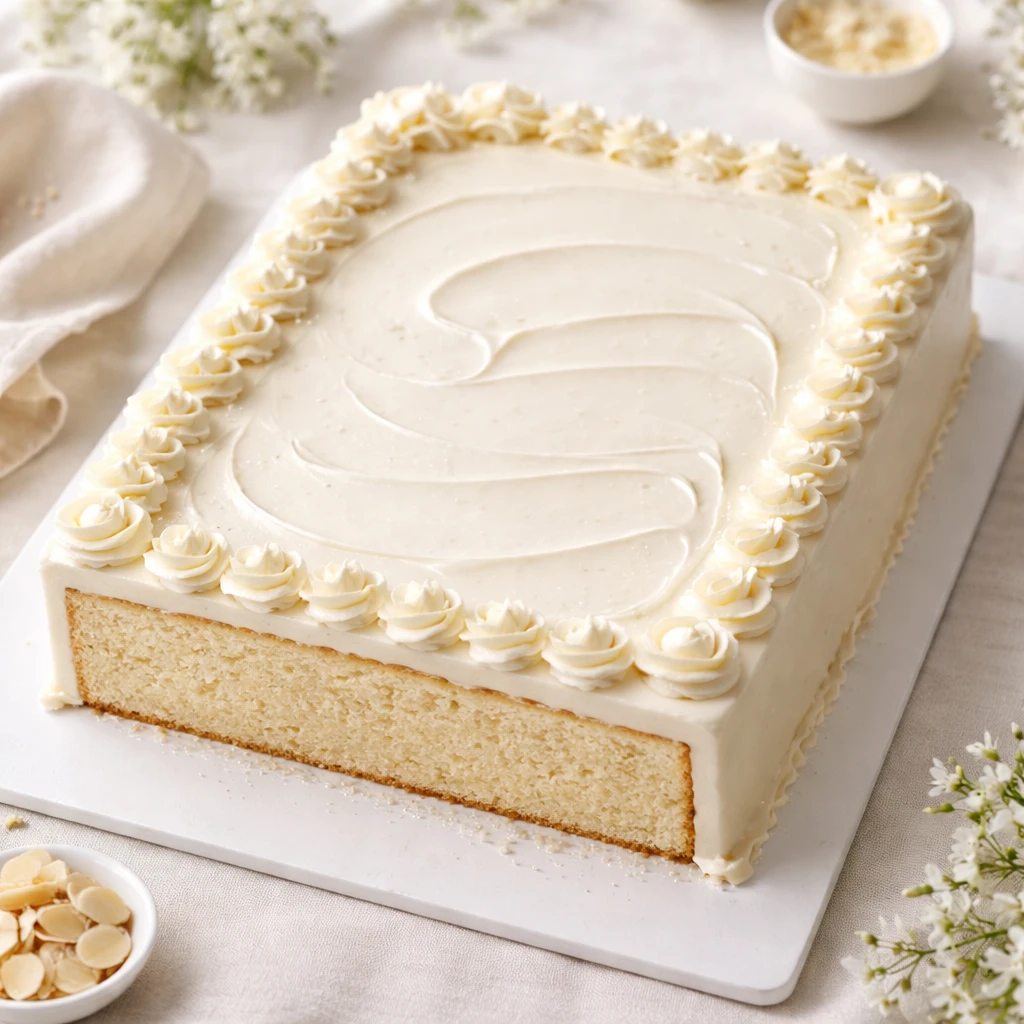
Wedding Sheet Cake Recipe With Elegant Almond Vanilla
Ingredients
Method
- Position your oven rack in the center. Preheat the oven to 350°F. Line a 9x13-inch baking pan with parchment paper, letting the edges overhang slightly.
- Sift together cake flour, all-purpose flour, baking powder, baking soda, and salt into a medium bowl. Whisk to combine evenly. Set aside.
- In a large bowl, cream room temperature butter and granulated sugar together for 3-4 minutes until light and fluffy. Scrape the bowl and paddle frequently. The mixture should look pale and increased in volume.
- Add eggs one at a time, beating for 30-45 seconds after each addition. Wait until each egg is fully incorporated before adding the next. This creates a stable emulsion.
- Combine sour cream and whole milk in a small bowl. Stir in vanilla extract and almond extract. Set aside.
- Alternate adding dry ingredients and the sour cream mixture to the butter mixture, starting and ending with dry ingredients. Add in three additions of flour and two additions of sour cream mixture. Mix on low speed until just combined after each addition. Do not overmix.
- Pour batter into prepared pan. Spread evenly using an offset spatula. Tap the pan gently on the counter to release air bubbles.
- Bake for 30-35 minutes. The top should spring back slowly when lightly touched, and a toothpick inserted in the center should come out with a few moist crumbs. Do not overbake.
- Cool the cake in the pan for 15 minutes. Run a thin knife around the edges. Invert onto a wire rack and cool completely, about 45 minutes. The cake should be room temperature before frosting.
- For the buttercream, beat room temperature butter for 2-3 minutes until pale and creamy. Scrape the bowl frequently.
- Add sifted powdered sugar in four additions, beating on low speed until combined after each addition. The mixture will look crumbly at first.
- Once all sugar is incorporated, add heavy cream, vanilla extract, almond extract, and salt. Beat on medium speed for 3-4 minutes until light and fluffy. The buttercream should be smooth and spreadable, not grainy.
- If the buttercream is too soft, refrigerate for 10-15 minutes. If it's too stiff, add cream by the teaspoon and beat again.
- Level the cooled cake if the top has domed. Place the cake on your serving board or cake base. Frost the top and sides with buttercream using an offset spatula. Work smoothly and deliberately. Chill for 15 minutes to set the base layer before piping any decorative details.